

Short answer
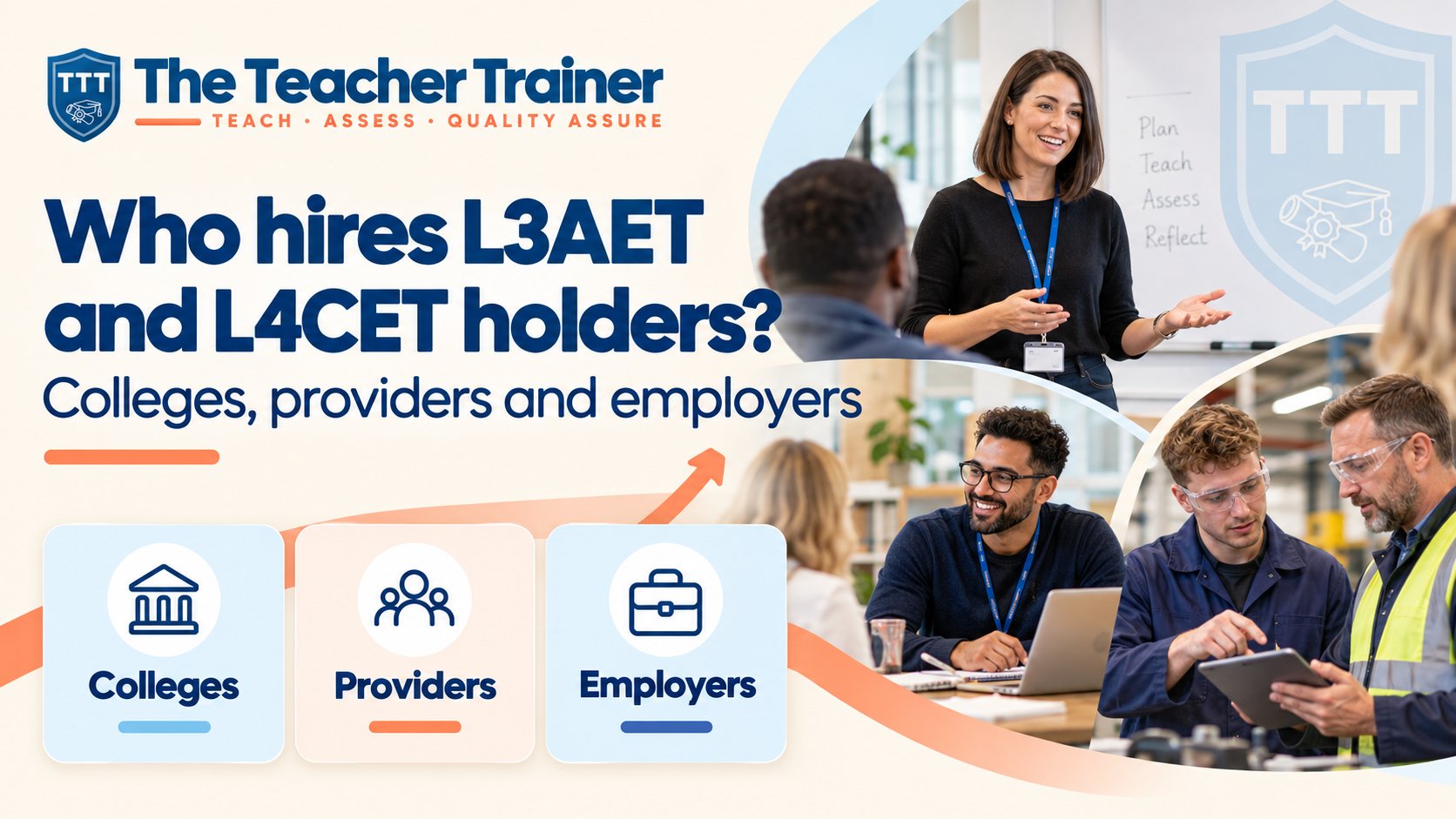
Further education colleges, independent training and apprenticeship providers, adult and community learning services, public services such as the NHS, police, fire and armed forces and employers who run their own training. The L3AET gets you started. The L4CET suits people already teaching. Neither one on its own qualifies you as a classroom teacher in a state school.
What each qualification proves
The Level 3 Award in Education and Training (L3AET) shows that you can plan a session, deliver it inclusively, check that learning has happened and reflect on it afterwards. You prove it with written work and a micro-teach of at least fifteen minutes. No teaching placement is needed, which is why it is the usual first step for people moving into training from another career.
The Level 4 Certificate in Education and Training (L4CET) goes further. It covers deeper planning, inclusive practice and assessment, and it asks for 30 hours of teaching with your own learners. Employers read it as evidence that you are already doing the job and doing it properly.
Both are regulated qualifications, awarded by an Ofqual-regulated awarding organisation. Neither expires.
Further education colleges
FE colleges are the largest single employer of people with teaching qualifications outside schools. They hire lecturers, tutors, instructors and assessors across vocational subjects: construction, hair and beauty, motor vehicle, health and care, catering, engineering, IT and more.
For sessional or hourly-paid work, many colleges will take the L3AET plus strong industry experience. For permanent lecturing posts, adverts often ask for a full teaching qualification such as the Level 5 Diploma in Teaching, or for you to start one within an agreed period after joining. The L4CET sits between the two and is common among people who teach part-time alongside their trade.
Tip
Read the person specification, not just the job title. "Teaching qualification or willingness to work towards one" usually means your L3AET gets you through the door and the college expects progression.
Training and apprenticeship providers
Independent training providers deliver apprenticeships, adult skills courses, short courses and compliance training. They hire tutors, trainers and tutor-assessors, and the L3AET is the qualification they name most often for trainer roles.
Tutor-assessor jobs combine teaching with assessing apprentices in the workplace. For those, providers look for a teaching qualification and an assessor qualification together, typically the L3AET with the Level 3 Certificate in Assessing Vocational Achievement (CAVA).
Adult and community learning services, run by local councils, hire tutors for evening and daytime classes. Here the L3AET is often the minimum and the L4CET helps with longer contracts.
Public and uniformed services
The NHS, police forces, fire and rescue services, the prison service and the armed forces all train their own people, and they want their trainers qualified. Clinical educators, police trainers, fire service instructors and military instructors regularly hold the L3AET, and in some cases it is a stated requirement for the role.
Security is a specific case. To train door supervisors and other SIA licence holders, the trainer route combines the L3AET with the Level 3 Award in Deliverers of Conflict Management Training and the Level 3 physical intervention award. You can see the pathway for each of these sectors on the sector finder.
Employers who train their own staff
Corporate learning and development teams, manufacturers, utilities, logistics firms and retailers run induction, product, safety and leadership training. Many ask their internal trainers to hold the L3AET so that training is planned and checked to a recognised standard. If your employer wants a group trained at once, see Corporate.
The L3AET gets you in the room. The L4CET shows you have been teaching in it.
What about schools?
To work as a classroom teacher in a state school in England you normally need qualified teacher status (QTS). The L3AET and L4CET do not give you QTS.
There are still school roles where these qualifications help: teaching assistants and HLTAs who want to deliver sessions, cover supervisors and vocational instructors in schools that run technical courses. The long route from the L5DiT to QTLS is set out on the teaching ladder. Check the current Department for Education position on QTLS and QTS before relying on it for a school post.
Which one to take first
If you are not teaching yet, start with the L3AET. It needs no placement and it is the qualification most trainer adverts ask for. If you already teach your own learners and can evidence 30 hours, the L4CET is the better use of your time. If you want a permanent college post, plan for the L5DiT as your next step. If you are unsure, the Course Quiz takes about a minute.
Questions people ask
Can I teach in a college with just the L3AET?
Often yes, for sessional or hourly-paid work, especially where you bring strong industry experience. Permanent lecturing posts usually ask for a Level 5 teaching qualification or a commitment to start one.
Is the L4CET enough to become an FE lecturer?
It is enough for many part-time and fractional posts. Some colleges ask for the Level 5 Diploma in Teaching for permanent full-time roles.
Can I teach in a secondary school with the L3AET?
Not as a qualified classroom teacher. State schools in England normally require QTS. The L3AET helps in support, cover and some instructor roles.
Do I need a degree to take the L3AET or L4CET?
No. You need to be comfortable writing in English and, for the L4CET, have access to your own learners.