

Short answer
Get a Level 5 teaching qualification such as the Level 5 Diploma in Teaching (L5DiT), hold Level 2 English and maths, join the Education and Training Foundation (ETF) as a member, then complete its six-month professional formation while you teach. When ETF approves your portfolio, you are awarded QTLS.
What QTLS is
Qualified Teacher Learning and Skills (QTLS) is awarded by the Education and Training Foundation (ETF), formerly through the Society for Education and Training (SET). It confirms that you meet the Professional Standards for teachers and trainers in further education and skills.
QTLS is recognised in law as equal to Qualified Teacher Status (QTS). That means a QTLS holder who keeps their membership can be employed as a qualified teacher in schools in England.
QTLS is a status, not a course. You earn it by teaching.
The route, step by step
 1
Teach in further education and skills
You need to be teaching post-14 learners in FE and skills, such as a college, training provider or adult learning, and to stay in regular teaching through professional formation.
 2
Get your Level 2 English and maths
ETF asks for recognised Level 2 English and maths, such as GCSE grade 4 (C) or Functional Skills Level 2.
 3
Gain a Level 5 teaching qualification
You need an accepted FE teaching qualification at Level 5 or above. The Level 5 Diploma in Teaching (L5DiT) is the current one. The older Diploma in Education and Training (DET) and an FE PGCE or Cert Ed also count.
 4
Hold a subject qualification
You normally need a Level 3 or higher qualification in the subject you teach.
 5
Join ETF as a member
Professional formation is only open to ETF members. Join before you apply.
 6
Find a supporter
Ask a qualified colleague, such as your line manager, head of department or mentor, to support you through the process.
 7
Apply for a cohort
ETF runs professional formation in cohorts with set application deadlines. Check the current dates and fee on the ETF website before you plan.
 8
Complete professional formation
Over six months you teach groups of five or more learners for at least 230 hours, record your CPD, reflect on your practice against the Professional Standards and build an online portfolio.
 9
Keep your status
Once QTLS is awarded, keep your ETF membership and keep up your CPD. If your membership lapses, so does the recognition in schools.
Where the L5DiT fits
The L5DiT is the qualification step, and the biggest one. It needs a teaching placement of at least 250 hours, including 150 hours of teaching, a second teaching location, a subject specialist mentor and a pastoral mentor. Planning those early makes professional formation much easier, because you will already be teaching enough hours.
If you are new to teaching, start with the L3AET, then the L4CET, then the L5DiT. You do not have to take every level, but each one builds on the last. Which teaching qualification should you choose?
Tip
Keep a CPD log and copies of your certificates from the day you start the L5DiT. ETF asks for certificates and evidence when you apply, and you will want them in one place.
QTLS and teaching in schools
QTLS lets you be employed as a qualified teacher in a school in England. It is a good route for people who teach a vocational subject in FE and want the option of a school role. If you only ever want to teach children in a school, a PGCE with QTS is the more direct route.
Questions people ask
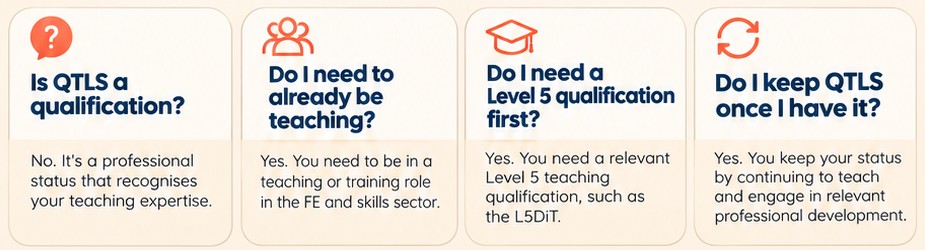
Is QTLS a qualification?
No. It is a professional status awarded by ETF after you are qualified and have completed professional formation.
Can I get QTLS with the L4CET?
No. You need a Level 5 or higher FE teaching qualification, such as the L5DiT.
How long does professional formation take?
About six months, during which you teach at least 230 hours.
Is QTLS the same as QTS?
It is recognised in law as equal to QTS for teaching in schools in England, as long as you keep your ETF membership.