

Short answer
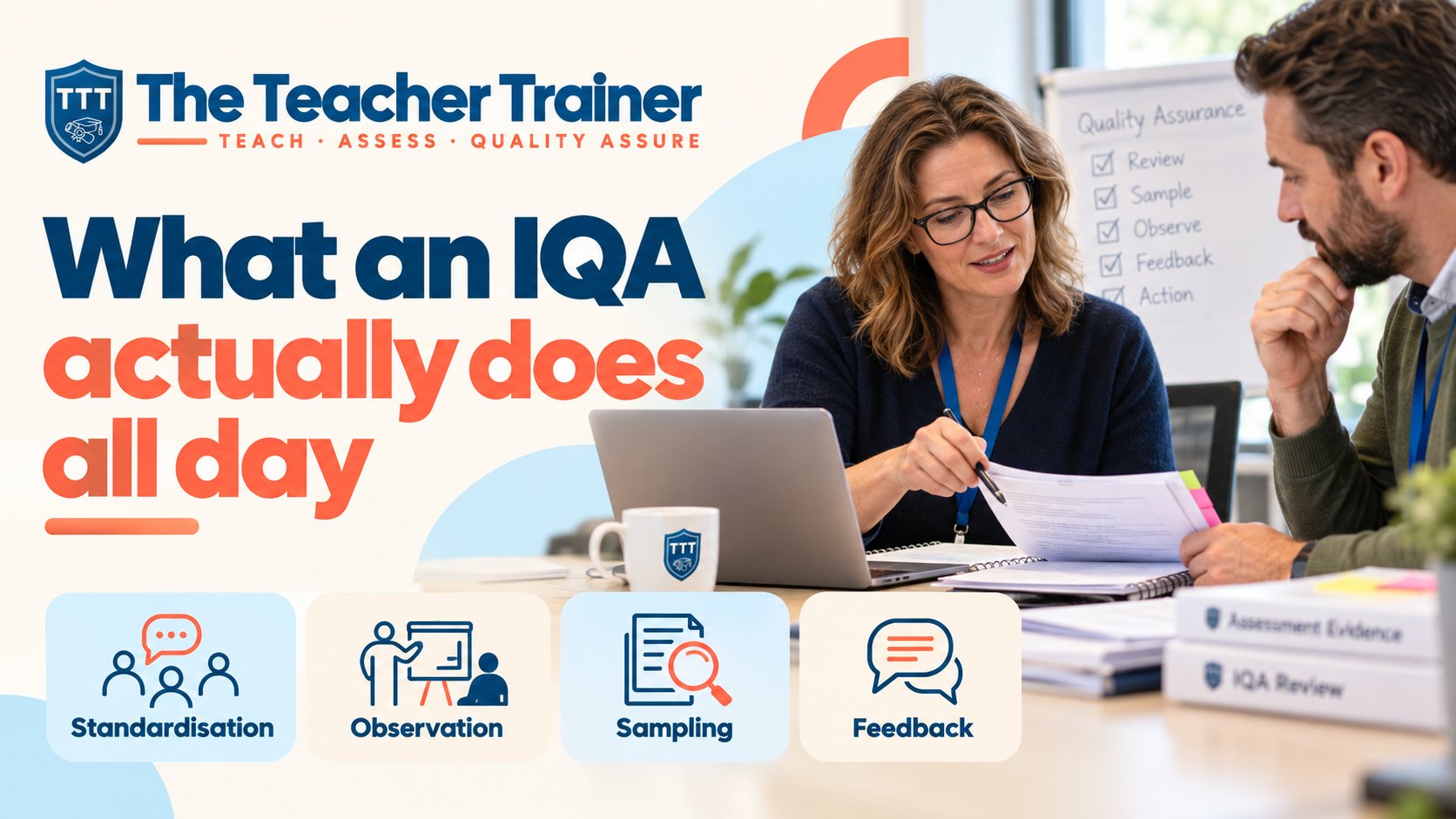
An internal quality assurer (IQA) checks that assessors in a centre make consistent, fair and accurate decisions. Day to day that means planning a sampling schedule, reviewing assessed work, observing assessors, running standardisation meetings, giving assessors feedback and keeping the records the awarding organisation's external quality assurer checks.
What an IQA is for
An assessor decides whether a learner has met the standard. An IQA checks that assessors are making those decisions consistently and fairly. If two assessors would judge the same piece of evidence differently, the IQA's job is to find that out and fix it before it reaches a certificate.
IQAs usually work in training providers, colleges, employers who run their own qualifications and apprenticeship providers. Many are experienced assessors who still assess part of the week.
A typical day
- Morning: check the sampling plan. See which assessors, units and learners are due for sampling this week.
- Sample assessed work. Review portfolios or assessment records and decide whether each assessment decision is valid, reliable and properly evidenced.
- Observe an assessor. Watch an assessor carry out an assessment, in person or remotely, and see how they question, observe and record.
- Give feedback. Tell each assessor what is working and what to change, in writing, with an action and a date.
- Afternoon: standardisation. Run or prepare a meeting where assessors judge the same evidence and compare decisions.
- Keep records. Log every sample, observation and action so the trail is complete.
How sampling works
IQAs do not check everything. They sample, and the sample is planned by risk. New assessors, new qualifications, assessors with a history of errors and units that are hard to judge get sampled more. The aim is to cover every assessor, every unit, every assessment method and every site over time.
Tip
A good sampling plan is written before the assessing starts, not after. It shows the EQA that quality assurance is planned, not reactive.
Standardisation
Standardisation is where the team agrees what "meets the standard" looks like. The IQA brings real, anonymised evidence and every assessor judges it. Where decisions differ, the team talks it through until they agree, and the IQA records what was decided. It is the most effective way to stop assessors drifting apart.
Sampling finds problems. Standardisation stops them happening again.
Working with the EQA
The awarding organisation sends an external quality assurer (EQA) to check the centre. The EQA looks at the IQA's sampling plans, records and actions as much as at learners' work. Centres whose quality assurance is trusted can be given Direct Claims Status, which lets them claim certificates without waiting for an EQA visit. We hold it ourselves, which is why our learners' certificates are claimed quickly.
Becoming an IQA
Most IQAs start as assessors. To practise, you need the L4AIQAAPP, which includes real sampling across a team of assessors. If you only need the theory, the L4AUIQAAPP covers it, and its fee comes off the practical award later. To lead a team of IQAs, the L4CLIQAAPP adds planning and managing the quality function.
Boltjobs puts typical IQA salaries in FE and training providers at £28,000 to £40,000, with lead IQA and quality manager roles usually in the £40,000 to £48,000 bracket. More on pay is in what FE tutors and assessors earn.
Questions people ask
What does an IQA do?
An IQA checks that assessors make consistent, fair and accurate decisions by sampling their work, observing them, running standardisation and keeping records for the external quality assurer.
What qualification do I need to be an IQA?
The L4AIQAAPP to practise as an IQA, or the L4CLIQAAPP to lead a team of IQAs.
Do I need to be an assessor before becoming an IQA?
Most IQA roles expect assessing experience, and most IQAs start as assessors.
How much does an IQA earn?
Typically £28,000 to £40,000, with lead IQA roles around £40,000 to £48,000.