
Short answer
Online learning lets you qualify around your job and family, for less, with more one-to-one time with your tutor. It also changes how good you are at your job and what work opens up to you. Its drawbacks are real too: it is easy to put off, it can feel lonely and you need the right kit. Every one of them can be handled, as long as you know about them before you start.
I have been teaching adults since 2001, first in India and in the UK since 2008, and running this centre since 2012. In that time I have watched online learning go from something people apologised for to the way most working professionals now get qualified. I have also seen exactly where it goes wrong.
Most articles on this subject are either sales pitches or warnings. This one is neither. It is meant as background reading before you start any of our courses: what online study actually involves, what it gives you, where it trips people up and how to make it work.
 What online learning actually involves
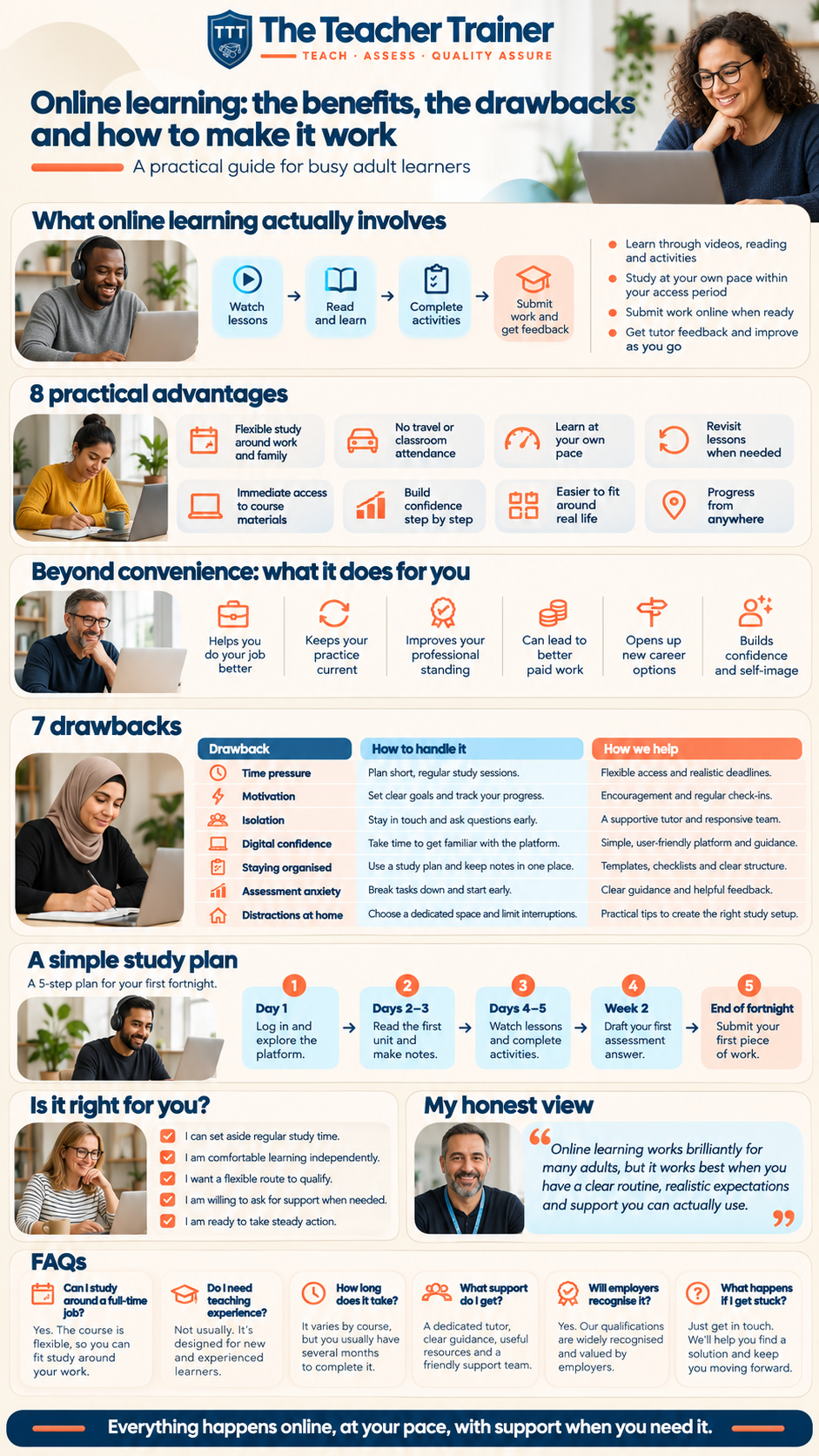
"Online learning" covers a lot of different things, from a free video series to a full university degree. When we talk about it here, we mean studying for a regulated qualification through an online learning platform, at your own pace, with a tutor who marks your work.
In practice that looks like this. You log in, work through the course one unit at a time and complete written assignments as you go. You submit them online and your tutor marks them and sends written feedback. If a piece needs more work, you put it right and send it back. Alongside the written work, most teaching and assessing qualifications include practical evidence: delivering a session, assessing real candidates or carrying out quality assurance activity, usually recorded on video.
There are no timetabled lessons and no weekly deadlines. That freedom is the whole point, and, as you will see below, it is also the part you need to manage. If you want the step-by-step version, how the online course works walks through it from enrolment to certificate.
 The practical advantages
These are the reasons most people choose to study online in the first place. They are about fitting a qualification into a life that is already full.
Study when it suits you
There is no timetable to fit around. You can study before work, on a lunch break, after the children are in bed or on a quiet Sunday morning. If you work shifts or your week changes from one month to the next, this alone often decides it.
Study wherever you are
All you need is a computer and an internet connection. Learners who live a long way from a college, travel for work or are posted overseas can take exactly the same qualification as someone who lives round the corner. Bad weather, train strikes and road closures stop mattering.
Learn at your own pace
Read a unit twice if it did not land the first time. Move quickly through topics you already know from years of training people at work. Nobody holds you back and nobody rushes you.
Less effort spent getting there
No commute, no parking and no sitting in a classroom after a full shift. You log in on your own device and pick up exactly where you stopped last time. Your energy goes into learning, not into getting there.
Lower overall cost
The fee is only part of what a course costs. Travel, parking, lunches out, childcare and unpaid time off add up quickly over weeks of classes. Studying from home removes most of those costs, so you keep your pay while you qualify.
More one-to-one time with your tutor
In a classroom, the confident learners ask most of the questions. Online, every question goes straight to your tutor, so you get an answer written for you. Many learners tell us they ask far more questions online than they ever would in front of a group.
Everything in one place
The learning materials, your submissions, your feedback and your tutor all sit together. You are not keeping track of printed handouts or trying to remember what was said in a session three weeks ago. You can go back to any of it whenever you need to.
Digital skills you will use
Uploading work, joining video calls, recording a session and organising files online are now part of everyday teaching, assessing and quality assurance. Studying online gives you practice in all of them before you need them at work.
The best time to qualify is the time you already have: an evening, a weekend, a lunch break.
 Beyond convenience: what it does for you
Convenience gets people started. What keeps them going, and what they tell us about afterwards, is how the qualification changes their work and how they feel about it.
You become better at your job, straight away
What you learn goes into your work the next day: planning a session, giving useful feedback, assessing fairly, checking someone has really understood. Because you keep working while you study, you improve while you learn rather than afterwards.
You stay current
Standards and expectations change in every sector. A current, regulated qualification shows employers you are keeping up, and it keeps you eligible for roles that ask for one.
You see your job with fresh eyes
If you have done the same work for years, a course lets you step back from it. You pick up new ideas, question old habits and go back to work with more energy for it.
Your standing at work changes
Colleagues and managers notice when someone qualifies. It often leads to being asked to train new starters, sign off competence or take on a quality role.
More work opens up
Qualified teachers, assessors and IQAs can apply for jobs and freelance work that are closed to people without the certificate. For many learners that means a pay rise, extra paid work or both. See what FE tutors and assessors earn, by region.
You see yourself differently
A recognised qualification changes how you think of yourself. You stop being someone who "helps out with training" and start being a qualified teacher, trainer, assessor or IQA.
It is something that is yours
Learning something new and seeing yourself get better at it lifts your mood. Many of our learners tell us the course gave them something to look forward to that was theirs alone.
Steady progress feels good
Short units, feedback within 24 to 72 hours and a tutor you can message turn a big qualification into a series of small wins. That rhythm is what keeps people going.
You finish something you chose
Completing a qualification you picked, at your own pace, feels very different from sitting through a compulsory training day. You set the pace and you earn the certificate.
You grow in independence
Finishing an online course shows you can plan, manage your time and see something through without being chased. Employers notice, and so will you.
The people you train benefit
Good teachers and assessors raise standards for everyone around them. When you train people well, they work more safely, more confidently and more skilfully, and the people they serve benefit too.
 The drawbacks, and how to handle each one
None of these is a reason not to study online. Each is a reason to go in with a plan.
It is easy to put off
Without a class to turn up to, "I will do it tomorrow" can turn into weeks. This is the single most common reason online learners stall.
How to handle it
Pick two or three fixed study slots a week and put them in your diary like appointments. Short and regular beats long and rare.
How we help
You have 365 days to finish, with a Day 355 cut-off for final submissions, and your named tutor is a message or call away when you get stuck. Marking within 24 to 72 hours keeps you moving.
You can feel on your own
Studying at the kitchen table is quieter than a classroom, and some people miss the chat and shared problem-solving.
How to handle it
Use every chance to talk to people: ask your tutor questions, join the live sessions and tell colleagues what you are working on.
How we help
You are never just a login. You have a named tutor by email and phone, plus live calls, webinars and group Q&A sessions.
Answers are not instant
When you have a question at 11 p.m., there is nobody in the room to ask.
How to handle it
Write the question down, carry on with something else and send it in one clear message. You will often work out the answer while writing it.
How we help
Marking comes back within 24 to 72 hours, theory and observations alike (weekends excluded), and you can always Book a Call.
You need the right kit and skills
A slow connection, an old computer or not knowing how to upload a file can turn simple tasks into frustrating ones.
How to handle it
Check before you enrol that you have a computer, a working internet connection and basic computer skills. Written work is expected at around Level 2 English (GCSE level).
How we help
Every course page has an "Am I ready?" check so you can see in a minute whether you have what you need.
Practical skills are harder to show
Teaching and assessing are practical jobs. You cannot learn to teach a room purely by reading about it.
How to handle it
Plan your practical work early: who your learners or candidates will be, where you will teach or assess and how you will record it.
How we help
The practical parts are built in. On the L3AET you deliver and record a micro-teach of at least 15 minutes to learners aged 14 or over, with one resubmission if it needs another go. On the L3CAVA you assess real candidates. See how the micro-teach works.
Worries about recognition
Some people assume an online qualification counts for less than one gained in a classroom.
How to handle it
Check the qualification itself, not how it is delivered. Look it up on the Ofqual Register and confirm the awarding organisation.
How we help
Our courses are Ofqual-regulated qualifications. The certificate is issued by the awarding organisation and does not say how you studied. Each course page links to its entry on the Ofqual Register (GOV.UK).
Not every provider is good
Online learning is only as good as the people behind it. Some providers sell a login and very little support.
How to handle it
Ask what support you get, how fast marking comes back and what happens if you need more time, before you pay.
How we help
Read 7 questions to ask before you buy training, then ask us all seven. We are happy to answer them.
Flexibility is the biggest strength of online learning. It is also the biggest risk.
 Making it work: a simple study plan
The learners who finish are rarely the ones with the most free time. They are the ones who set things up well in the first fortnight. Five steps cover most of it:
Check you are ready
Use the "Am I ready?" check on your course page: age, Level 2 English, a computer and any practical requirement your course has.
Book your study slots
Two or three regular slots a week, written in your diary. Tell the people you live with when they are.
Sort your practical early
If your course has a micro-teach, observations or real candidates, arrange the people and the place in your first few weeks, not your last.
Submit little and often
Send work in as you finish each piece. Feedback comes back within 24 to 72 hours, so small submissions keep you moving.
Ask early
The moment something does not make sense, message your tutor. A five-minute question now saves a resubmission later.
If you work full time, studying around a full-time job goes further, with real weekly hours and a sample routine.
 Is online learning right for you?
If you can tick most of these, online study is very likely to work for you:
✓I can find two or three hours most weeks
✓I can plan my own time without someone chasing me
✓I have a computer and a reliable internet connection
✓I am comfortable writing at around GCSE level
✓I have, or can arrange, the practical setting my course needs
If two or more are a firm no, talk to us first. Sometimes the answer is a different course, a later start date or a little preparation before you enrol. If you are weighing up online against a classroom, online vs classroom teacher training compares the two side by side.
 My honest view
When I started teaching in the UK, the only route to a teaching qualification was a college timetable fixed months in advance. Plenty of capable people never got qualified, not because they could not do it but because the timetable did not fit their lives. That is why we built our courses online.
Online learning is not easier than a classroom. In some ways it asks more of you, because nobody makes you turn up. But for people who already work, care for family or work shifts, it is often the only way the qualification happens at all. Plan a little, ask for help early and it works.
The best course is the one you will actually finish. Online makes finishing possible for far more people.
Your next step
Every one of our courses is online and self-paced, with a named tutor, marking within 24 to 72 hours and 365 days to finish. Take the Course Quiz to find the right qualification, or Book a Call and we will talk it through with you.
Download the one-page summary of this guide
Questions people ask
Is an online qualification worth less than a classroom one?
No. The certificate is issued by the awarding organisation and is the same whichever way you study. It does not say how you studied.
How long do I have to finish?
You have 365 days of access to the online course, with a Day 355 cut-off for final submissions.
Is everything done online?
The learning and your submissions are online. Some qualifications also need practical evidence, such as the micro-teach on the L3AET or assessing real candidates on the L3CAVA.
How quickly is my work marked?
Within 24 to 72 hours, theory and observations alike (weekends excluded).
How many hours a week do I need?
It depends on the course and how quickly you want to finish. Many learners manage with a few hours a week.
What if I fall behind?
Tell your tutor early. You have 365 days, so a busy month is rarely a problem. If you need longer, a 30-day extension is available for an Extension fee of £125 + VAT.